[Part 2] Summary:
Europe’s aggressive talent attraction (Blue Card 2.0) contrasted with US net migration decline and macroeconomic impact. Essential for business English learners and those tracking global economic trends.
🌍 Europe Rolls Out the Red Carpet, While the US Closes Its Doors: A Tale of Two Strategies
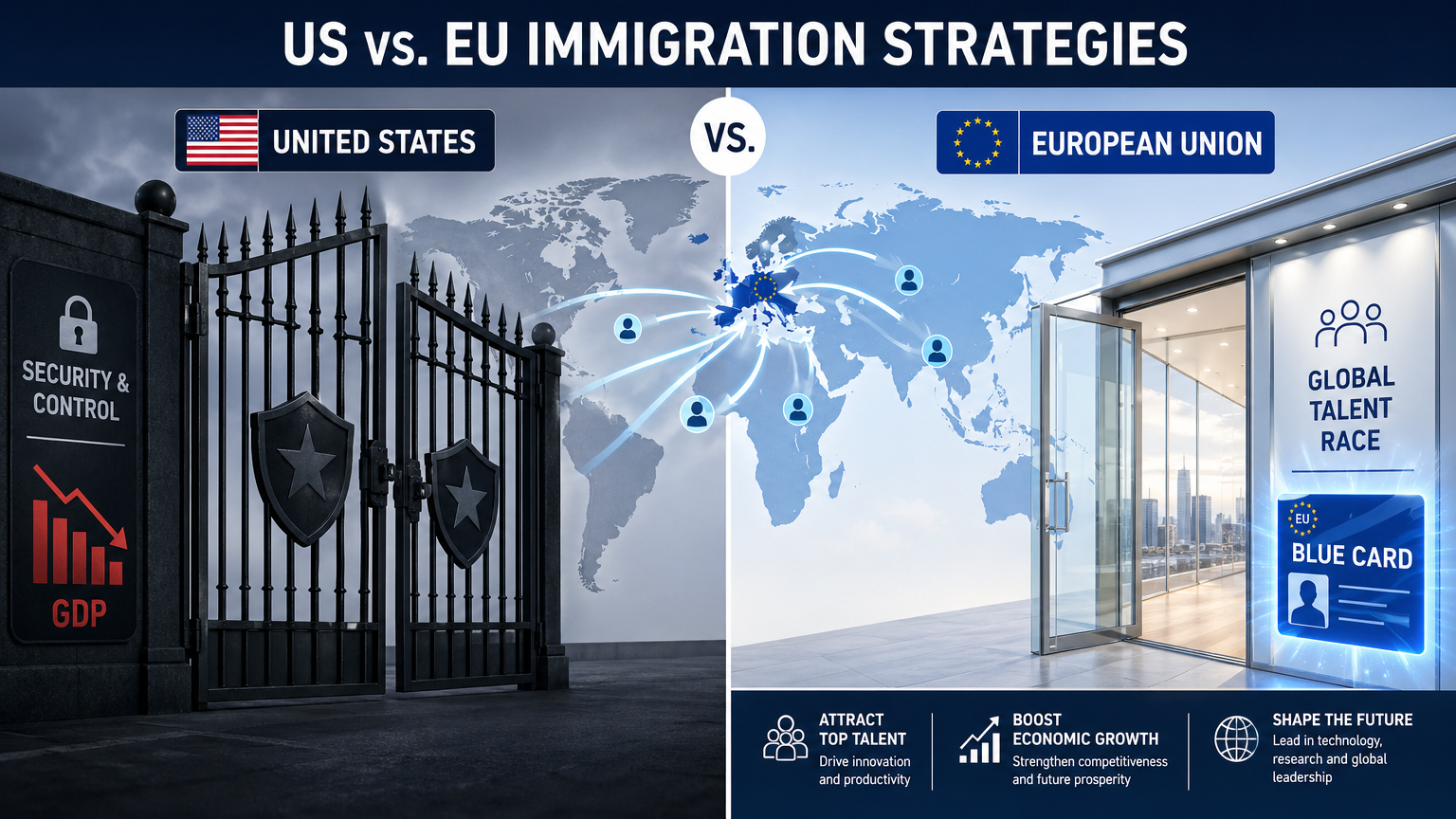
01/ The Great Divide: US vs. EU Immigration Philosophies
|
Feature
|
Europe (EU Blue Card 2.0)
|
United States (Current Trend)
|
|
Primary Goal
|
Attract high-skilled talent, address demographic decline, boost economic competitiveness
|
Border security, control illegal immigration, national security
|
|
Approach
|
Proactive, streamlined, talent-centric
|
Restrictive, enforcement-heavy, politically charged
|
|
Key Mechanisms
|
Lower salary thresholds, faster PR paths, family reunification
|
Increased deportations, reduced legal immigration, third-country deals
|
|
Economic Impact
|
Aims to fill skill gaps, drive innovation, sustain growth
|
Risks labor shortages, reduced consumer spending, GDP dampening
|
02/ Key Takeaway: Europe’s Talent Magnet vs. America’s Economic Price Tag
EU Blue Card 2.0: Europe’s Bold Bid for Talent
- What it is: The European Union’s revamped visa scheme designed to attract highly skilled non-EU professionals. It’s explicitly positioned to compete with programs like the US H-1B visa, offering more attractive and streamlined conditions.
- Key Features: Lower salary thresholds, faster paths to permanent residency, and easier family reunification. Countries like Germany are particularly proactive, actively using the Blue Card to draw in skilled workers.
- The Goal: To address demographic challenges, maintain economic competitiveness, and fill critical skill gaps in key industries.
US Net Migration Decline & Macroeconomic Consequences (Brookings Report)
- A Sobering Statistic: The Brookings Institution’s report reveals that the US experienced ‘Negative Net Migration’ in 2025, a trend projected to continue into 2026. This is a first in at least half a century.
- Economic Impact: This decline leads to a significant ‘Dampening Effect’ on the labor force, consumer spending, and overall Gross Domestic Product (GDP). The report estimates a reduction in GDP growth by approximately
[Effect on real GDP growth in 2025 and 2026 from reduction in immigrants' labor supply and consumer spending, in percentage points]
Source: Authors' estimates.
- 2025 - - 2026 - Low High Low High Direct effect on GDP growth -0.18 -0.17 -0.08 -0.05 Additional effect owing to reduction in consumer spending -0.02 -0.02 -0.16 -0.07 Additional effect owing to higher saving among immigrants in U.S. -0.06 0.00 -0.08 0.00 Total effect on GDP growth -0.26 -0.19 -0.32 -0.12
Note: The first row shows the effect on real GDP growth from the prior year resulting from a change in the production of goods and services by immigrants, once the new immigration policy reduces labor supplied by immigrants. The second row shows an additional effect on economic growth stemming from the unexpected reduction in consumer spending relative to the prior year, in essence the multiplier effect. The third row shows the estimated effect of greater precautionary saving, which is assumed to occur only in the low scenario. The fourth row shows the total of the prior three rows. See the main text for explanation of assumptions underlying the two immigration scenarios.
- Why This Matters: For those who believe in the dynamism immigrants bring, this report is a stark warning. The numbers clearly show that while border security might be a potent political slogan, it comes with a clear and substantial economic price tag. This isn't just about politics; it's about the fundamental health of the economy.
💡 My Take: Talent is the New Currency in Global Power
"In the global race for human capital,
is your talent being pursued as a 'valuable asset,'
or are you merely a 'cost' to be managed?"
(글로벌 인재 쟁탈전의 시대, 여러분의 재능은 추구해야 할 '가치 있는 자산'으로 대접받고 있나요, 아니면 단순히 관리되어야 할 '비용'으로 취급받고 있나요?)
📚 Level Up Your English: Key Terms for Business & Global Economy
1. Macroeconomic (거시경제적인)
- 해설: 개별 기업이나 가계가 아닌, 국가 전체의 성장률, 금리, 인플레이션 등 큰 숲을 보는 관점입니다. 비즈니스 리포트 서두에서 '대외 환경'을 분석할 때 절대 빠지지 않는 단어입니다.
- 비즈니스 활용: "The investment committee is concerned about the macroeconomic instability caused by fluctuating trade policies." (투자 위원회는 변동성 큰 무역 정책으로 인한 거시경제적 불안정을 우려하고 있습니다.)
- 상황 분석: 경영진 보고 시, 특정 부서의 문제를 넘어서 시장 전체의 판도를 흔드는 외부 요인을 언급할 때 이 단어를 사용하면 논의의 격이 올라갑니다.
2. Net Migration (순이민)
- 해설: (유입 인구 - 유출 인구)의 값입니다. 비즈니스 관점에서는 단순한 숫자가 아니라 '노동력 공급의 파이'와 '내수 시장의 규모'를 결정짓는 핵심 지표로 해석해야 합니다.
- 비즈니스 활용: "With negative net migration, we must accelerate our automation strategy to offset the shrinking local talent pool." (순이민이 마이너스로 돌아선 상황에서, 줄어드는 현지 인력 풀을 상쇄하기 위해 자동화 전략을 가속화해야 합니다.)
- 상황 분석: HR 전략이나 중장기 시장 진출 계획을 세울 때, 인구 구조 변화에 따른 리스크를 경고하는 지표로 활용하세요.
3. Dampening Effect (억제/위축 효과)
- 해설: 활활 타오르는 불에 물을 뿌리듯, 경제 성장이나 소비 심리를 꺾어버리는 부정적인 영향을 뜻합니다. 'Negative impact'보다 훨씬 시각적이고 전문적인 표현입니다.
- 비즈니스 활용: "The prolonged high-interest rates have had a dampening effect on consumer discretionary spending." (지속적인 고금리가 소비자의 선택적 지출에 위축 효과를 가져왔습니다.)
- 상황 분석: 실적 저하의 원인을 분석하거나, 정부의 규제가 시장 활력을 어떻게 떨어뜨리고 있는지 논리적으로 비판할 때 매우 효과적입니다.
4. Economic Competitiveness (경제 경쟁력)
- 해설: 국가나 기업이 글로벌 시장에서 뒤처지지 않고 살아남아 이익을 창출할 수 있는 근본적인 힘입니다. 최근에는 '기술 패권'이나 '인재 확보 능력'과 동의어로 쓰입니다.
- 비즈니스 활용: "Strengthening our R&D capabilities is not just an option; it is vital for maintaining our economic competitiveness against emerging rivals." (R&D 역량 강화는 선택이 아닙니다. 신흥 경쟁사들에 맞서 우리의 경제 경쟁력을 유지하기 위한 필수 과제입니다.)
- 상황 분석: 투자 유치나 신사업 승인을 위해 우리 회사의 '해자(Moat)'를 설명하거나 국가적 차원의 지원이 필요한 이유를 설득할 때 사용하세요.
5. Demographic Challenges (인구 통계학적 문제)
- 해설: 저출산, 고령화, 숙련 노동자 부족 등 인구 구조에서 기인하는 피할 수 없는 위기들을 통칭합니다. 비즈니스에서는 '지속 가능성(Sustainability)'을 위협하는 가장 큰 변수로 꼽힙니다.
- 비즈니스 활용: "Given the demographic challenges in Europe, the Blue Card 2.0 is a strategic necessity to secure the next generation of innovators." (유럽의 인구 통계학적 문제를 고려할 때, 블루카드 2.0은 차세대 혁신가를 확보하기 위한 전략적 필수 선택입니다.)
- 상황 분석: 시장의 장기적 전망을 어둡게 보는 근거를 제시하거나, 반대로 이러한 위기를 타개하기 위한 혁신적인 솔루션(인재 영입, AI 도입 등)의 정당성을 부여할 때 쓰입니다.
💬 Join the Conversation
What is your take on the global race for talent? Should nations prioritize border security like the US, or open their arms to secure economic longevity like the EU?
If you found this analysis valuable, please hit the Like (❤️) button and Subscribe for more deep dives into the global economy and advanced English. Thanks.
Next Up: Part 3, "The K-Blue Card: Korea’s Strategic Roadmap." Stay tuned!
👉 Sneak Peek for Part 3: In our final installment, we’ll turn the spotlight on South Korea. Drawing lessons from both the US and European experiences, we’ll explore strategic pathways for Korea to become a ‘Global Talent Hub’ through a ‘K-Blue Card’ and robust tech-security partnerships. Don’t miss it if you’re keen on current affairs and advanced English!


